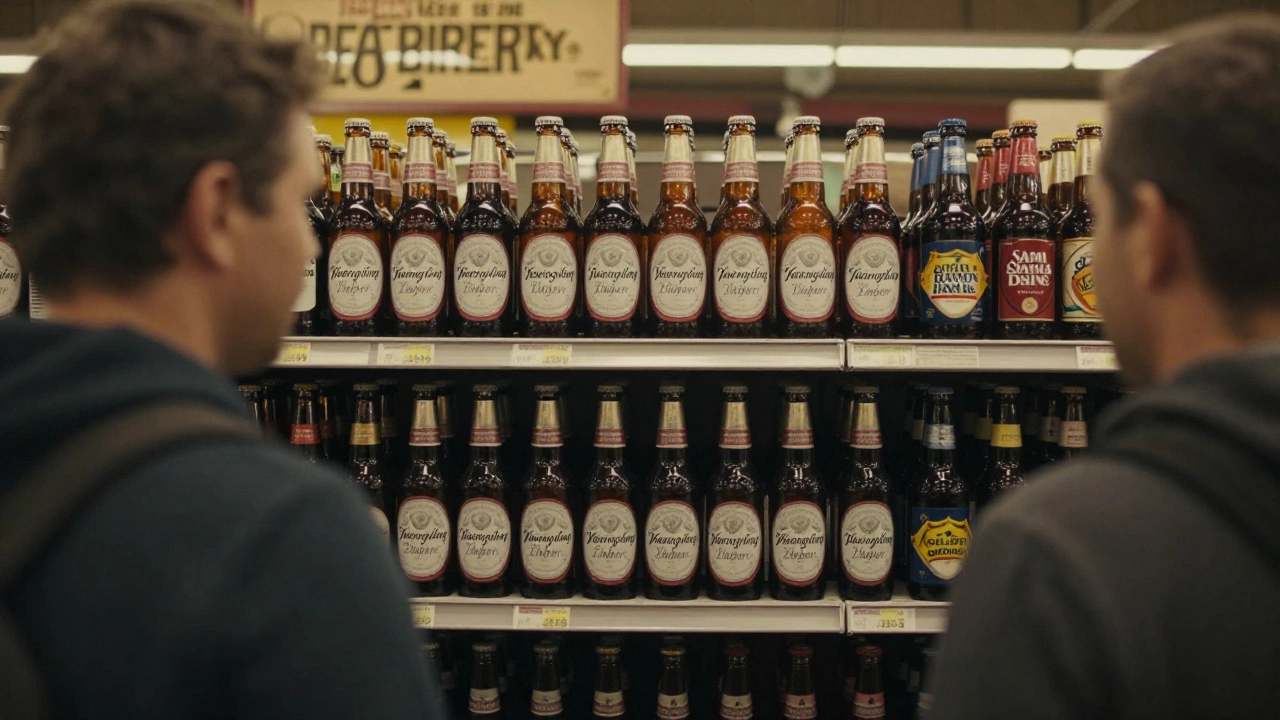
Craft Beer Preference Quiz
Discover which craft beer aligns with your personal values and taste preferences. Answer these 3 questions to find your match.
When someone asks what the #1 craft beer in America is, they’re not just asking for a name-they’re asking for a story. Because the answer isn’t simple. It’s not just about who sells the most. It’s about what people believe craft beer means. And right now, that story is split right down the middle.
Yuengling Traditional Lager: The Volume Champion
If you measure by pure sales numbers, the #1 craft beer in America is Yuengling Traditional Lager. It’s not flashy. It doesn’t have hazy IPA clouds or barrel-aged complexity. It’s a clean, amber lager with 6.5% ABV and a crisp, slightly sweet finish. You’ll find it in grocery stores, gas stations, and corner bars from Pennsylvania to Florida. In 2024, Yuengling sold nearly 2.9 million barrels-more than any other craft brewery in the U.S.
And yes, it still counts as ‘craft.’ According to the Brewers Association’s official rules, a brewery must be small (under 6 million barrels a year), independent (less than 25% owned by big beer), and traditional (flavor from fermentation, not additives). Yuengling meets all three. It’s still family-owned, still run by the fifth generation of the Yuengling family. It’s been brewing since 1829. That’s older than the U.S. Civil War.
But here’s the problem: most craft beer fans don’t feel like it’s craft. In a 2025 survey of 12,500 beer drinkers who call themselves craft enthusiasts, 68% said Yuengling doesn’t feel like a craft beer. Why? Because it doesn’t taste like one. It doesn’t push boundaries. It doesn’t experiment. It’s consistent, reliable, and everywhere. That’s not a bad thing-but it’s not what most people picture when they think of craft.
Sam Adams Boston Lager: The Classic Contender
Sam Adams Boston Lager sits at number two in sales, with about 1.2 million barrels sold in 2024. It was the beer that put American craft on the map in the 1980s. Jim Koch’s story-brewing in his kitchen, knocking on bars with a suitcase full of samples-is the origin myth of the whole movement.
It’s a balanced, malty lager with a touch of hop spice and 4.9% ABV. It’s not bold, but it’s dependable. And unlike Yuengling, it’s the beer people remember when they first stepped away from mass-market lagers. It’s the gateway beer. It’s the one you bring to your uncle’s barbecue because you know he’ll like it.
But even Sam Adams isn’t immune to the changes. The company’s sales have been flat for years. Their marketing still leans on nostalgia. And while they’ve expanded into sours, IPAs, and non-alcoholic options, the core Boston Lager still carries the weight of being the original. It’s not the biggest anymore. But it’s still the most respected.

Sierra Nevada Pale Ale: The Craft Spirit
Then there’s Sierra Nevada Pale Ale. At 5.6% ABV and 38 IBU, it’s hoppy, resinous, and unmistakably American. It’s the beer that inspired hundreds of small breweries to start brewing their own IPAs. In 2024, it sold about 1 million barrels-third in volume, but first in influence.
When craft beer fans say ‘this is what craft beer should taste like,’ they’re often thinking of Sierra Nevada. It’s the beer you find at festivals, on tap at local pubs, and in the fridge of brewers who don’t even drink the big brands. It’s not the best-selling, but it’s the most iconic. In the same 2025 survey, 72% of craft beer lovers named Sierra Nevada Pale Ale as their definition of quintessential craft beer.
And here’s the twist: Sierra Nevada is also one of the few large craft breweries that still runs its own distribution. They don’t rely on big beer conglomerates. They built their own network. That matters to people who care about independence.
The Bigger Picture: Craft Beer Is Shrinking
Here’s the hard truth: craft beer as a whole is losing ground. In 2024, craft beer volume dropped 4%, while total beer sales only fell 1%. Americans are drinking less beer overall-and even less craft beer. The $28.3 billion craft beer market in 2024 was down from $28.6 billion the year before.
Why? Because tastes are changing. People aren’t just drinking beer anymore. They’re drinking low-ABV options, non-alcoholic brews, and hard seltzers. Athletic Brewing’s non-alcoholic beers grew 18.7% in 2024. That’s the future. And it’s not happening at Yuengling’s scale.
Meanwhile, the craft beer world is exploding in size-but not in the way you’d think. There are now 9,796 craft breweries in the U.S. Eighty-five percent of them produce fewer than 1,000 barrels a year. That’s less than one truckload. Most of them are in basements, garages, or tiny taprooms. They’re not on grocery shelves. They’re not in national ads. But they’re where the real innovation is happening.

The Debate: What Even Is ‘Craft’ Anymore?
The Brewers Association says Yuengling is craft. Bart Watson, their chief economist, says it’s part of America’s brewing heritage. That’s true. But Stan Hieronymus, author of Brewed in America, says the spirit of craft has moved on. He argues that craft isn’t just a set of rules-it’s a mindset. Innovation. Risk. Experimentation.
And that’s the core tension. Is craft about size and ownership? Or is it about flavor, creativity, and community?
Big beer companies know this. That’s why they buy small breweries and slap ‘craft’ on the label. Constellation Brands bought Ballast Point. Anheuser-Busch owns Elysian, Golden Road, and others. They call it ‘craft-washing.’ And consumers are catching on. A 2025 report from Beverage Daily found that people are starting to distinguish between ‘craft-labeled’ beers and those that feel genuinely craft.
So when you ask what the #1 craft beer is, you’re really asking: Do you care about sales numbers? Or do you care about what the beer stands for?
What’s Next? The Real Future of Craft Beer
The future isn’t in the top three. It’s in the 9,000+ breweries making under 1,000 barrels a year. It’s in the hazy IPAs from Tree House Brewing. It’s in the sour ales from American Solera in Tulsa. It’s in the oatmeal stouts brewed in basements in Boise and Portland.
These breweries don’t have national distribution. They don’t show up on beer aisle charts. But they’re the ones winning awards, filling taprooms, and inspiring new brewers every day.
And they’re the ones leading the next wave: hyper-local ingredients, sustainable packaging, low-ABV options, and community-driven brewing. That’s where the energy is. That’s where the passion is.
Yuengling might be the biggest. But it’s not the most exciting. Sierra Nevada might not be the biggest anymore. But it still represents the soul of what craft beer was meant to be. And the real #1 craft beer? It’s probably the one you haven’t tried yet-the one brewed down the street, in a 500-gallon tank, by someone who’s just trying to make something good.
So next time you’re at a beer festival, skip the big-name booths. Walk past the Yuengling tap. Go find the guy with the handwritten sign: ‘New Batch-Only 20 Cases.’ That’s where the real #1 is waiting.
Is Yuengling really a craft beer?
Yes, by the official definition from the Brewers Association-Yuengling meets all three criteria: it’s small (under 6 million barrels/year), independent (still family-owned), and traditional (uses fermentation for flavor). But many beer drinkers argue it doesn’t fit the spirit of craft because of its massive scale and lack of innovation. So legally, yes. Culturally, it’s debated.
What’s the best-selling craft beer in America?
As of 2024, Yuengling Traditional Lager is the best-selling craft beer by volume, with nearly 2.9 million barrels sold. It outsells Sam Adams Boston Lager (1.2 million barrels) and Sierra Nevada Pale Ale (1 million barrels).
Why do craft beer fans dislike Yuengling?
Many craft beer drinkers associate ‘craft’ with innovation, small-batch production, and bold flavors. Yuengling’s Traditional Lager is a consistent, mass-distributed lager with no hops or experimental ingredients. It tastes like a classic American lager, not a craft beer. A 2025 survey found 68% of craft beer enthusiasts don’t consider it ‘truly craft.’
Is Sierra Nevada still considered a craft beer?
Yes. Sierra Nevada is independently owned, produces under the craft limit, and is widely seen as a pillar of the American craft movement. Its Pale Ale helped define the IPA style and remains a benchmark for hop-forward beers. Even though it’s large by craft standards, it’s still respected for its independence and innovation.
What’s the fastest-growing segment in craft beer?
Non-alcoholic and low-ABV beers are growing the fastest. Athletic Brewing’s non-alcoholic offerings saw an 18.7% sales increase in 2024. Consumers are also shifting toward hyper-local brews, sustainable packaging, and sessionable styles-especially among younger drinkers.
Categories