
BAC Calculator for Non-Alcoholic Drinks
Calculate Your Estimated BAC
See why non-alcoholic drinks (0.5% ABV or less) can't get you drunk, even when consumed in large quantities.
Let’s cut to the chase: no, there is no non-alcoholic drink that can get you drunk - not even close. Not if it’s made to legal standards. Not if it’s sold in a store in the U.S., the EU, Canada, or the UK. Not even if you chug ten cans in a row. And here’s why.
What Does ‘Non-Alcoholic’ Actually Mean?
The term ‘non-alcoholic’ isn’t just marketing fluff. It’s a legal definition. In the U.S., the Alcohol and Tobacco Tax and Trade Bureau (TTB) says any drink labeled ‘non-alcoholic’ must contain less than 0.5% alcohol by volume (ABV). In the EU, it’s the same. Some brands go even further and label themselves ‘alcohol-free’ - that means 0.0% ABV, with zero detectable ethanol. That’s not a guess. It’s measured with lab-grade gas chromatography.
Brands like Seedlip, Lyre’s, and Three Spirit all test their products to ensure they hit 0.0% ABV. Seedlip’s website says plainly: ‘0.0% ABV means zero ethanol content detectable by gas chromatography.’ That’s not marketing speak - it’s science. And it’s backed by the industry’s own rules. The Distilled Spirits Council of the United States (DISCUS) even penalizes companies that imply their non-alcoholic drinks can cause intoxication. In 2023 alone, they issued 17 corrective actions for misleading ads.
Why You Can’t Get Drunk on 0.5% ABV Drinks
Let’s do the math. For a 70kg adult to reach the legal driving limit in the U.S. - 0.08% blood alcohol concentration (BAC) - you’d need to drink about 10 liters of a 0.5% ABV beverage in under an hour. That’s more than two and a half gallons. Your stomach holds about 1 to 1.5 liters at most. Even if you could force that much liquid down, you’d drown in water before you’d get drunk.
Here’s what actually happens if you try: your body starts absorbing so much water, your blood sodium levels crash. That’s called hyponatremia. It causes headaches, nausea, seizures, and in extreme cases, brain swelling. The Journal of Clinical Medicine documented this in 2021 after reviewing several emergency room cases where people drank massive amounts of non-alcoholic beer trying to ‘get a buzz.’ None of them had measurable alcohol in their blood. All of them had dangerously low sodium.
A 2022 Yale study tested 127 people who drank three servings of Athletic Brewing’s Run Wild (0.5% ABV) within 30 minutes. The highest BAC recorded? 0.005%. That’s one-sixteenth of the legal limit. Barely detectable. And you’d need to drink over 20 cans to even get close to 0.08%. Impossible.
So Why Do Some People Say They Feel ‘Buzzed’?
If the science says it’s impossible, why do people swear they felt something? It’s not the alcohol. It’s your brain.
A University of Sussex study in 2019 gave people either 0.0% ABV drinks or plain water - but told everyone they were getting alcohol. Thirty-one percent of those who thought they were drinking alcohol reported feeling tipsy, relaxed, or even a little dizzy. The placebo effect is powerful. Your brain expects a buzz. It starts looking for one. You feel the warmth of the glass. The fizz. The ritual. Your mind fills in the rest.
That’s why people on Reddit’s r/SoberReddit say things like, ‘It’s the ritual, not the buzz.’ One user, u/SoberSara, wrote in May 2023: ‘I don’t feel drunk. But I feel calm. Like I’m celebrating without the crash.’ That’s not intoxication. That’s comfort. That’s psychology.
What About Kava, Adaptogens, and ‘Buzz’ Drinks?
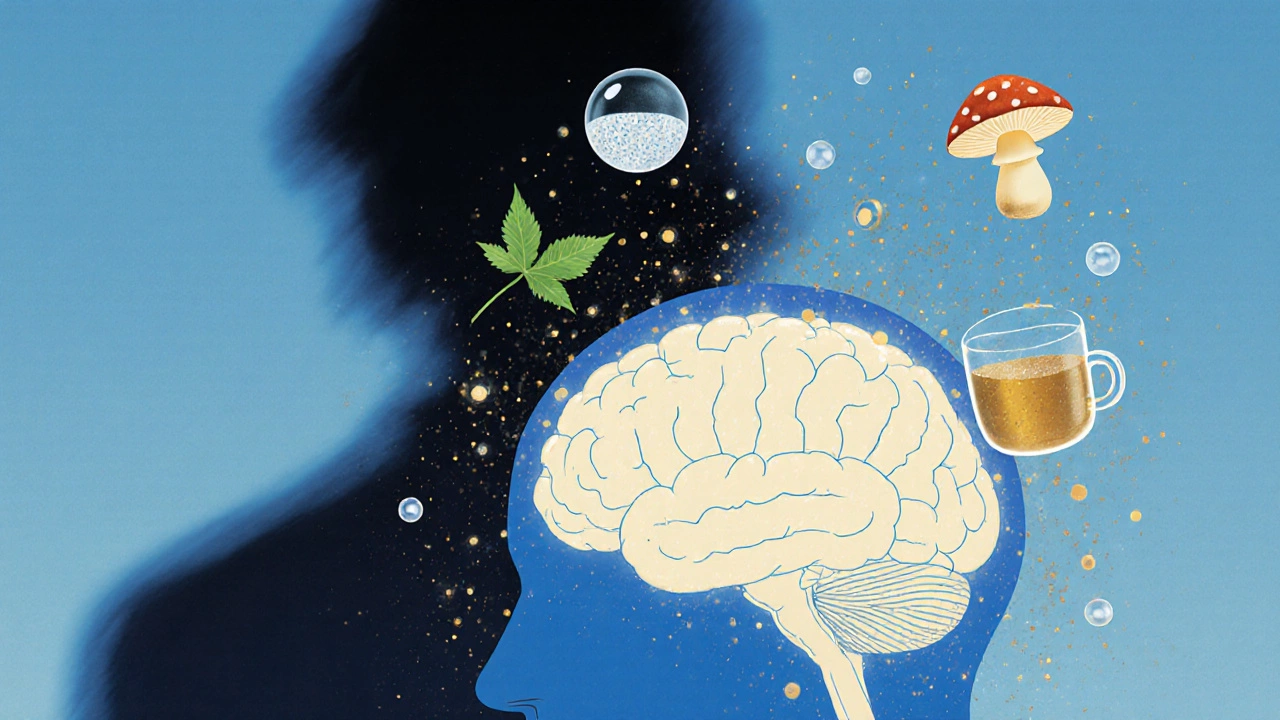
Some brands don’t even pretend to replicate alcohol. They’re building something new. De Soi, for example, makes apéritifs with reishi mushroom, L-theanine, and lion’s mane. These are adaptogens - natural compounds that help your body manage stress. They don’t touch your liver. They don’t slow your reflexes. They don’t raise your BAC.
A 2023 clinical trial on De Soi’s ‘Golden Hour’ drink found that participants had 18.7% better cognitive flexibility and a 11.2% drop in cortisol. That’s not a buzz. That’s clarity. That’s calm focus. It’s the opposite of being drunk.
And then there’s kava. Some people confuse kava tea with non-alcoholic drinks. Kava comes from the Piper methysticum plant. It’s a sedative. It makes you feel relaxed, maybe a little heavy. But it’s not ethanol. It doesn’t cause slurred speech, loss of coordination, or hangovers. The European Medicines Agency clarified in 2020: kava is not alcohol. It’s a different kind of effect entirely.
What About That Viral TikTok Video?
You’ve probably seen it. Someone takes a sip of ‘non-alcoholic beer,’ rolls their eyes, and says, ‘I’m so drunk.’ The video has millions of views. But here’s the truth: Health Feedback, a fact-checking group, analyzed it. They found the person was showing signs of hypoglycemia - low blood sugar - not intoxication. Shakiness. Dizziness. Confusion. All classic symptoms of skipping a meal, not drinking alcohol.
That’s the problem with social media. It turns coincidence into causation. Someone feels weird after drinking something. They assume it’s the drink. They don’t check if they ate. If they’re tired. If they’re stressed. If they’re just imagining it.
What About Bad Bottles? Are There Exceptions?
There’s one real exception - and it’s illegal. In 2021, German regulators pulled 12,000 bottles of a product called ‘Alko-free’ beer after testing showed it had 1.8% ABV. That’s not ‘non-alcoholic.’ That’s a mislabeled, poorly made product. It was an accident - a fermentation error. The company didn’t intend to sell alcohol. But they did. And they were punished for it.
That’s the only documented case in the last decade where a legally labeled non-alcoholic drink actually contained enough alcohol to cause mild intoxication. And it was an outlier. A mistake. Not a feature.
Why This Myth Keeps Coming Back
People want to believe. Especially those who used to drink. They miss the ritual. The social moment. The feeling of letting go. So they cling to the idea that maybe, just maybe, there’s a drink out there that gives them that without the cost.
But the truth is simpler: you don’t need alcohol to feel good. You need connection. You need calm. You need a drink that feels special, even if it’s just sparkling water with lime. That’s why the non-alcoholic market is growing at 10.5% a year. It’s not because people think they’re getting drunk. It’s because they’re choosing better.
28% of U.S. millennials now say they’re reducing alcohol to avoid intoxication. They’re not chasing a buzz. They’re chasing control. Clarity. Health. And the brands that win aren’t the ones pretending to be alcohol. They’re the ones offering something better.
What Should You Expect From Non-Alcoholic Drinks?
Expect flavor. Expect complexity. Expect ritual. Expect calm. Expect to feel like you’re part of the party - without the fog.
Don’t expect to stumble home. Don’t expect a hangover. Don’t expect your coworkers to notice you’re ‘off.’
What you’ll get instead? A drink that tastes good. A moment that feels intentional. A choice you can be proud of. That’s the real ‘buzz.’
Categories